


- Like-for-like grocery inflation slowed to 2.6%, the lowest rate since December 2024
- Sporting fixtures and hot weather drove the highest shopping frequency since March 2020
- Branded goods outgrew own label for the first time since August 2025, up 5.5%
 Take-home sales from the grocers accelerated to 3.3% as grocery price inflation slowed to 2.6% in the four weeks to 12th July 2026, the lowest rate since December 2024, offering shoppers further relief as it marks the fifth consecutive month of easing prices.
Fraser McKevitt, head of retail and consumer insight at Worldpanel by Numerator, commented: “Easing price rises will come as welcome news to shoppers, but the annual bill tells a fuller story. The average household spent £5,530 on groceries over the past twelve months to July, up £156 on the same period last year – a reminder that even as the rate of inflation cools, the cumulative cost of the weekly shop keeps climbing.”
Summer of sport drives record number of trips
July brought together major sporting fixtures and another spell of hot weather. With two reasons to keep topping up – whether for match day or another day in the sun – shoppers made 497 million trips over the four weeks, an average of 17 per household, and the highest figure recorded since March 2020.
Trips including beer or cider purchases rose 8% year on year. The no/low alcohol category saw a similar surge with trips up 10%, well ahead of growth across the wider alcohol category with 7.2% of the population purchasing a no/low alcohol product during the month.
Households continued to make the most of the sunshine with spending on burgers up 25%, frozen lollies up 17%, and bottled water up 23%. Wimbledon fortnight also added its own seasonal boost, with £77m spent on strawberries and £21m on cream, proof that some traditions never go out of fashion.
McKevitt, commenting on the latest figures, said: “Sport and sunshine combined to shape shopping habits this month, and England’s run in the tournament had a clear impact on the drinks aisle. With shoppers stocking up on matchday, and the day prior to the first three knockout matches, spending on beer rose 21% compared with the same days last year. That enthusiasm wasn’t shared in Scotland and Wales, however, where the comparable rise was just 2%.”
Convenience and brands come out on top
Convenience stores enjoyed a strong month with an increase of 7 million trips compared with same four weeks last year, as shoppers popped out for quick local runs.
Branded goods outgrew own label this month for the first time since last August, with sales up 5.5% against 4.0%. Soft drinks, confectionery and ice cream led the shift – categories where summer demand and impulse buying typically favour big names over own label.
Lidl leads in market share gains and Morrisons returns to growth
Over the 12 weeks to 12 July 2026 Lidl market share moved up by 0.5 percentage points, the largest gain for any grocer as sales at the discounter rose by 8.6%. Sales at online only specialist Ocado were up by 14.1% moving market share to 2.2%, up from 2.0% in the same time period last year.
Morrisons returned to share growth, claiming 8.5% of the market with an increase of 0.1 percentage points compared to 2025 as sales rose by 3.5%. Bouncing back from last year’s cyber issues, spending through the tills at Co-op increased by 5.6%, the fastest rate of growth since February 2021. As a result, Co-op share rose by 0.2 percentage points to 5.4%.
Sainsbury’s also gained market share, moving from 15.1% last year to 15.2% in the last 12 weeks with sales growing by 2.8%. Sales at Tesco, Britain’s largest supermarket, were up by 1.7% with a market share of 27.9%. While sales at Asda were down 1.1% on last year, this was a notable improvement on the -3.6% reported last month. Asda market share over the 12 weeks now stands at 11.5%. The fourth-largest grocer Aldi holds 10.8% share with sales growing by 0.7%.
Both Iceland and Waitrose kept market share flat compared to last year at 2.2% and 4.4% respectively. The former grew sales by 2.3%, while Waitrose saw an uptick of 2.5%. Beyond the grocers, grocery-only sales at M&S* increased by 16.0% over the 12 weeks, the fastest rate since May 2023.
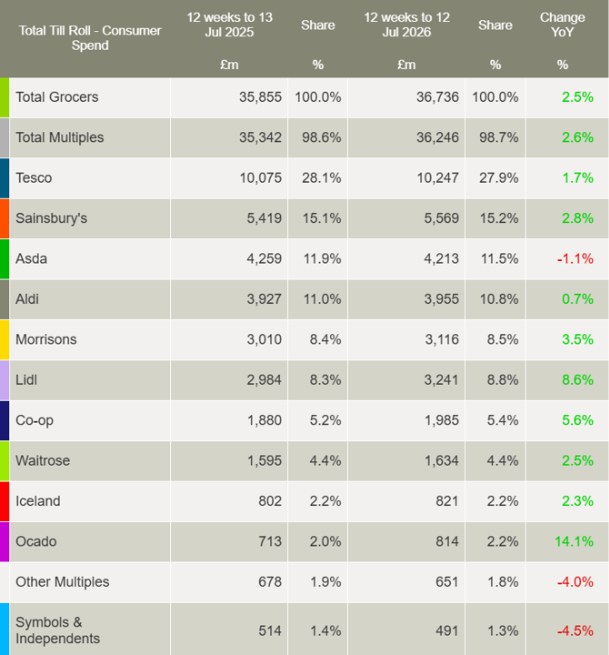 *Please note: with a higher proportion of clothing and general merchandise in its sales mix, M&S does not fall under the definition of ‘grocers’ using the Till Roll methodology on which the Worldpanel Grocery Market Share release is based. For this reason, a comparable market share number is not provided for M&S. The M&S growth number quoted in this update is for FMCG sales only, while the figures for grocers in the Grocery Market Share table cover total spending through supermarkets’ tills.
Comments are closed.