


- Take-home grocery sales up 2.0% in the four weeks to 6 September 2026, as like-for-like grocery price inflation increases to 2.3%
- Shoppers make 18 million fewer trips to the grocers in September than at the July peak, as the summer of sport and sunshine draws to a close
- Average spend per shopper on school uniform down 12.4% as cost-conscious parents seek value
 Take-home sales at the grocers increased by 2.0% in the four weeks to 6 September 2026, according to the latest data from Worldpanel by Numerator. Like-for-like grocery price inflation stood at 2.3%, rising at a faster rate than last month but still remaining relatively subdued.
August brought yet more warm weather and the conclusion to a summer of sport. But with the return to school and work high on the agenda for many, shopping habits have begun to shift, with 18 million fewer trips to the grocers recorded in the month compared to a peak of 497 million in July.
Fraser McKevitt, head of retail and consumer insight at Worldpanel by Numerator, commented: “The end of the summer holidays typically brings a cooling in trip frequency and a pivot towards priority purchases, and this year is no exception. While grocery inflation ticked up modestly last month, it remains significantly lower than the levels we saw earlier in the year, giving households some welcome breathing room.”
School uniform back on the shopping list
School uniform items reappeared in baskets and trolleys as the academic year returned, and value-for-money remained front of mind for parents this year as the cost of living continues to bite on household budgets.
Average spend per shopper on school uniform was £54.53, down from £62.29 in the corresponding period last year, or a 12.4% year-on-year decline, as shoppers turned to promotions and second-hand items to manage household budgets.*
Fraser McKevitt continued: “Value is the watchword for parents this back-to-school season. More than four in ten households (44%) are now prioritising keeping costs low above all else when it comes to buying uniform, even if that means compromising slightly on quality, while a third (33%) are still looking to strike a balance between the two.**
“It’s a clear sign that, for many families, the return to school is landing at a difficult time financially, and retailers who can offer reassurance on price without compromising on quality stand will stand in good stead.”
Favourites fill the lunchbox as terms begins
Classic lunchtime favourites were a visible presence in shopping baskets, as parents turned their attention back to filling up their children’s lunchboxes.
Sandwiches featured in more than half of all kids’ lunchboxes***, and the number of households with children buying loaves of bread rose by more than half a million in the seven days to 6 September compared to the previous week. The number buying satsumas (+29%) and cucumbers (+21%) also surged in the final week before term time.
Branded goods outpaced own label this month for only the second time in the past year, with sales up 3.7% compared to 2.9% growth for own label – a reversal of a pattern that has defined much of 2026. Despite this shift, shoppers have kept a strong appetite for promotions. Spending on grocery deals rose by £243 million, or 7.0% year on year, significantly outstripping full-price sales growth of just 1.4%.
Asda returns to growth
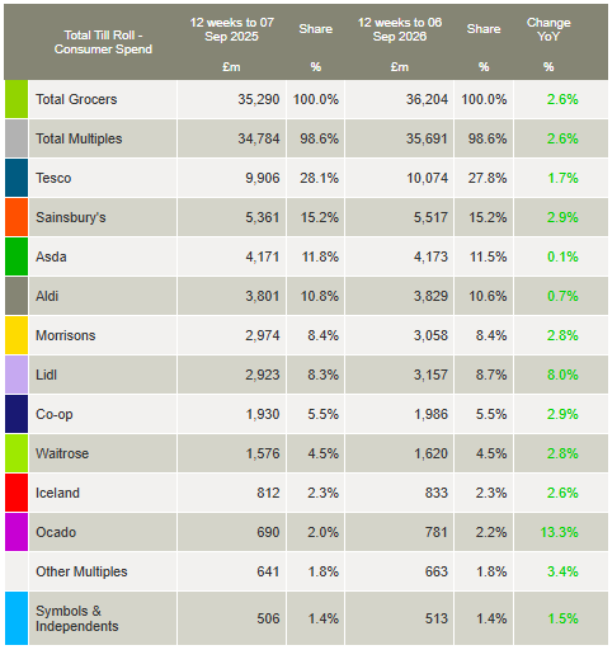
Sales at Asda rose by 0.1% over the 12 weeks to 6 September, as the grocer returned to growth for the first time since March 2024. The Leeds-based retailer now holds a market share of 11.5%, with a higher share of 16.0% in the North of England, and it is outperforming the market in categories such as hot drinks, ice cream and chilled poultry.
Ocado, with sales up by 13.3%, was the fastest growing grocer for the 30th consecutive time, used by 4.4% of households during the latest 12 weeks. Share for the online-only specialist increased by 0.2 percentage points, to 2.2% of the market.
The other grocer to win share, Lidl, moved up to 8.7% of the market, from 8.3% a year ago. Sales rose by 8.0%, helped especially by strong performance across confectionery, soft drinks and fresh produce.
Sales at Sainsbury’s were 2.9% higher than last year. The UK’s second largest grocer saw growth just ahead of Morrisons, which was up by 2.8%, meaning each retailer maintained a market share of 15.2% and 8.4%, respectively.
Tesco saw sales rise by 1.7%, with the UK’s largest supermarket now holding 27.8% of the market. Aldi accounts for 10.6% of the market, and spending through the tills at the discounter was 0.7% higher than a year ago.
Take-home sales at convenience retailer Co-op were up by 2.9%, with market share flat at 5.5%. Waitrose sales grew by 2.8%, with share stable on 4.5%. Matching the growth rate of the overall market, Iceland grew by 2.6%, with share of 2.3%. Grocery-only sales at M&S**** were 14.8% higher than a year ago.
 *Worldpanel, Fashion, Total Schoolwear including Footwear, 12 w/e data to 16th August 2026
**Worldpanel PanelVoice, Back to School Survey, Aug 2026, 991 households interviewed, Pulse Panel. Fieldwork dates: 24th August – 7th September 2026
*** Worldpanel Usage Foods, 57.5% of children’s lunchboxes contain a sandwich, 52 w/e 9 August 2026
****Please note: with a higher proportion of clothing and general merchandise in its sales mix, M&S does not fall under the definition of ‘grocers’ using the Till Roll methodology on which the Worldpanel Grocery Market Share release is based. For this reason, a comparable market share number is not provided for M&S. The M&S growth number quoted in this update is for FMCG sales only, while the figures for grocers in the Grocery Market Share table cover total spending through supermarkets’ tills.
Comments are closed.