


As grocery retailers and food distributors increase stockholding to improve product availability and support growing demand for chilled and frozen goods, pressure on cold storage capacity continues to rise. At the same time, escalating land, construction, and energy costs make efficient use of existing facilities more important than ever.
For many businesses, the most practical and cost-effective solution is not building new facilities, but making better use of the space they already have.
Cold stores are among the most expensive facilities to build and operate. Every extra cubic metre comes with a long-term energy commitment, meaning inefficient layouts can quickly erode margins. As a result, improving storage density within existing buildings has become a key strategy for enhancing profitability while avoiding the disruption and delays associated with new builds or relocation.
Irish forklift manufacturer Combilift, with nearly three decades of experience in material handling, has been at the forefront of helping businesses unlock hidden capacity in their warehouses, particularly in cold chain environments where space efficiency is critical.
A logical starting point is to assess current warehouse layouts and equipment. Traditional forklifts often require wide aisles and large turning circles, creating significant areas of unproductive space. In a cold store, this unused space still needs to be cooled, adding unnecessary energy costs. By contrast, narrow aisle solutions allow for tighter racking configurations, increasing storage capacity while reducing the volume of air that must be refrigerated.
CEO and Co-founder Martin McVicar explains: “We have always seen Combilift as much more than a designer and manufacturer of forklifts and other handling solutions. Space is one of the most valuable assets our customers possess, and if our trucks can make it work better for them in terms of storage density then everyone benefits.”
Combilift has a team of highly experienced design engineers who can provide companies with a free-of-charge warehouse design and layout service. This service demonstrates how warehouse space can be optimised based on the capabilities of Combilift’s products—often delivering gains of up to 50% without altering the building footprint, just by narrowing aisles and increasing racking height.
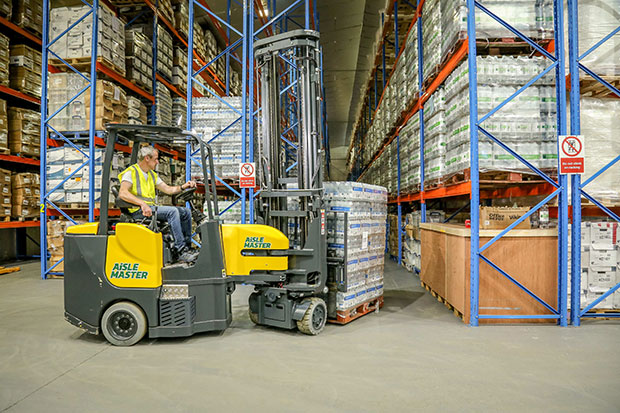
Equipment plays a central role in achieving operational efficiency. The Aisle Master articulated forklift is designed to operate in aisles as narrow as 1.6 metres while reaching heights of up to 15 metres. This enables operators to maximise both floor space and vertical storage. Its “truck-to-rack” capability also streamlines operations by allowing a single machine to handle unloading, transport, and storage, reducing double handling and improving productivity. Cold store conditions place additional demands on equipment. Reliable performance in low temperatures and during transitions between freezer and ambient zones is essential. Combilift’s cold store models are engineered to handle these challenges, preventing condensation issues and ensuring consistent operation. Features such as enclosed, heated cabs improve operator comfort, reducing fatigue and supporting productivity.
For operations where pedestrian equipment is more suitable, solutions like the Combi-WR reach stacker or the Combi-CS offer safe and efficient narrow-aisle handling. These units are designed for very narrow aisles and feature Combilift’s patented multi-position tiller arm, which allows the operator to stand safely at the side of the truck rather than behind it.
This design greatly reduces the risk of the operator being trapped between the truck and racking, and reduces aisle width, while also providing full visibility of the load and surrounding area.
Companies working in temperature-controlled logistics have already seen the benefits of switching to narrow-aisle equipment.
Jordan International Transport, based in Co. Tyrone, needed to expand its frozen and chilled seafood distribution without increasing the size of its freezer facility.
Distribution Manager Barry McIlvanna explains: “The freezer system has to work just as hard to cool the relatively unproductive areas set aside for access. With standard racking and conventional forklifts such as the counterbalance and pallet trucks we were previously using, only about half of the space could be used for storage. With the new system, this has risen to 85% so our freezer circuit can operate much more efficiently and therefore more cost-effectively.”
Similarly, JDM Food Group required equipment capable of working in very narrow aisles and extremely low temperatures.
For grocery distributors, food manufacturers, and cold-chain operators facing capacity constraints, optimising warehouse layout and materials handling equipment can provide a practical route to increasing storage density, improving productivity, and reducing operating costs — all without the need for costly expansion projects.
As businesses continue to seek ways to improve efficiency while controlling costs, making better use of existing cold storage space may prove to be one of the most effective investments available.
For more information, visit www.combilift.com.
Comments are closed.