


Most brands still treat convenience as a smaller, faster version of grocery. A format defined by proximity, speed and top-up purchasing. A channel you activate when your main grocery strategy needs extending.
But convenience isn’t defined by store size, shelf count or format. It’s defined by shopper intent: why shoppers are there, what they need, the problem they’re trying to solve and the mission they are trying to complete, writes Stanley Oyovota, Digital Media & Shopper Analytics Manager at Co-op Media Network (CMN).
That distinction matters because convenience shoppers have a different mindset to grocery shoppers. Their decisions are shaped less by pre-planned lists and category loyalty, and more by the context that brought them into the store at that moment.
When you analyse convenience behaviour at scale, what emerges isn’t a single channel. Instead, it’s a collection of distinct shopper missions, each with its own commercial dynamics.
Our analysis of more than 1.57 billion convenience baskets across 2024 and 2025 identified seven structurally distinct shopper missions, each with its own basket mix, timing profile, demographic skew and spend pattern. These are not product categories. They are behavioural contexts. And they differ far more than most brands assume.
One store, many different shopper mindsets
The contrast between missions is striking.
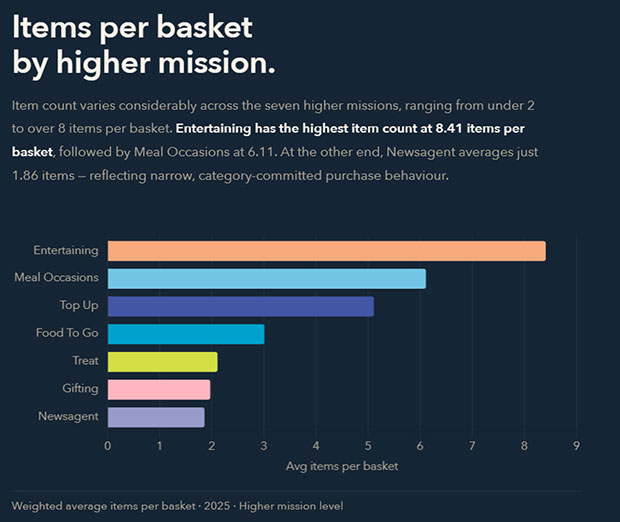
Food To Go peaks between midday and 3pm, averaging £5.03 across just over three items. It skews younger and is broadly gender balanced. The shopper is solving a time-pressured need and knows exactly what they’re looking for.
Entertaining peaks on Friday and Saturday evenings, averaging £21.88 across 8.4 items. It skews towards 37–50-year-olds and reflects planned social behaviour. This shopper isn’t topping up. They’re preparing for an occasion.
Newsagent missions happen predominantly before midday, average £11.09 with fewer than two items, and skew heavily towards shoppers aged 66 and over. The behaviour is habitual, focused and category-led, with the mission largely formed before the shopper enters the store.
Same channel. Same store. Completely different shopper states.
And this is before accounting for how the same mission varies across the week. Top Up peaks on a Sunday, accounting for 45% of all Sunday baskets, as shoppers prepare for the week ahead. Food to Go drops sharply at the weekend, accounting for under 20% of Sunday baskets compared to over 26% mid-week.
The convenience environment is not static. It shifts continuously throughout the day and week as different shopper missions rise and fall.
Why mission matters more than format
This is where many brands still get convenience planning wrong.
Most retail media and shopper marketing is structured around category logic; grouping products and audiences by what they are, not by the context in which they are being purchased. Format is often used as a proxy: EC Urban stores reach one type of shopper, Local Supermarkets reach another.
But shoppers don’t think in categories, they think in missions.
Mission is often a stronger predictor of basket composition, spend level and shopper profile than store format or product category alone.
Take Top Up as an example. A Top Up shopper in an EC Urban store has an average basket value indexed at 100 compared to a shopper completing the same mission in a Local Supermarket who has a basket value indexed at 242. The format influences the outcome, but the behavioural state remains consistent.
This is a fundamentally different way of understanding convenience. Format becomes an amplifier of behaviour rather than the primary explanation for it. Brands planning purely by format are measuring the amplifier, not the signal.
What winning brands are doing differently
Brands that are beginning to plan around mission context rather than category placement are doing something fundamentally different. They are reaching audiences defined by observed purchase behaviour, not modelled demographics.
They are activating media around the time of day and day of week when their most relevant mission peaks, rather than defaulting to format or location.
They are recognising that the same loyalty member completes different missions at different times and behaves differently in each, which means a single audience segment contains multiple distinct commercial opportunities depending on context.
The context changes the behaviour, the opportunity changes with it, and loyalty data reinforces the point.
Members consistently outspend non-members as they are already more deeply engaged with the category, which means mission-level audience targeting reaches a disproportionately high-value shopper. Top Up members spend £3.07 more per trip than non-members. Meal Occasions members spend £2.21 more.
The future of convenience planning
The closer a brand’s planning aligns to real-world mission context, the more precisely it can reach the right shopper at the right moment. Not through inference or approximation. Through observed transaction data at national scale, across over a billion shopping trips.
Convenience is not a channel. It never was. It is a set of distinct human needs, repeating millions of times a day, each one a different brief. The brands that learn to read those briefs, and plan against them, will find an audience that category logic has been leaving on the table for years.
Comments are closed.