



- UK households shop cautiously as inflation impacts average spend per visit (+2.5%) which has increased every month since October.
- Protein (+9.6%) and fibre (+14.1%) based foods saw considerable growth in the last 26 weeks well ahead of total FMCG growth.1
- Ocado (+14.2%) was the fastest growing retailer ahead of Lidl (+9.8%) while M&S (6.3%) and Waitrose (+6%) maintained strong sales due to Christmas and New Year spending.
Total Till sales at UK major supermarkets grew (+4.1%) in the last four weeks ending 24th January 2026, up from 3.0% in December, according to new data released today by NielsenIQ (NIQ). Despite this, NIQ data shows unit growths fell by -0.6% as shoppers took stock on personal finances after a busy Christmas period.
Inflation continues to impact UK households as it returns to the top of mind for many shoppers. The data shows that average spend per visit increased by +2.5%, amounting to ?22.08, impacted by inflation. Whilst frequency of visits was up (+1.4%), many households shopped cautiously for their weekly groceries as items in the shopping basket fell (-2.3%).2
As we saw last year, UK shoppers in 2026 are increasingly focusing on improving their health and wellness, with 1 in 4 households saying that Health is their number one priority for the year ahead. As such, shoppers are increasingly ‘looking behind the label’ as they seek out more knowledge about nutrition. 3
This impacted January sales as growing consumer awareness increased sales of both Protein (+9.6%) and Fibre (14.1%) based foods, resulting in considerable value growth in the last 26 weeks.1 And furthermore in the last 4 weeks, sales of Supplements (+18.4%) and Minerals (+9.2%) have seen generous growth. 4
In line with shoppers’ health and nutrition priorities, category performance saw Meat/Fish/Poultry (+7.7%) become the fastest growing super category with units also in growth (+1.3%). No/low alcohol drinks also gained share as No/Low Cider sales (+28%) and No/Low Spirits rose (+8%).4
eCommerce remains the fastest growing FMCG channel with value sales growth of +9.0% and market share increasing to 14.2%.5 There was continued softness in the Convenience channel with sales falling -0.4% against last year as shoppers shifted spend back to supermarkets and to online. 4 However, shopping missions remain at the core in a cold and wet January as Rapid Delivery saw a growth of +27% of their customer base vs last January. 6
Ocado (+14.2%) retained its position as the fastest-growing retailer ahead of Lidl (+9.8%). Meanwhile, at M&S (+6.3%) and Waitrose (+6%) sales were strong, helped by Christmas and New Year spending. Whereas sales at Co-op (-0.6%) dropped.
Mike Watkins, Head of Retailer and Business Insight at NielsenIQ, said: “Shoppers have entered 2026 with caution and a need to continue to balance budgets. This is felt most by two-thirds of households who still expect to be moderately or severely impacted by cost-of-living increases.”
“However, what’s interesting is that as well as a shift to essential food and drink there is continued interest in health and nutrition, fuelled by new product launches. For example, we are seeing a 20% boost to sales of cereal bars where there is a protein claim.” 1
Watkins added: “Looking ahead to Q1, with weak sentiment, some persistent inflation and shoppers looking to save money, we anticipate Total Till growth of around 3% to 3.5% and unit growth expected to remain stuck in the range of -0.5% to flat until Easter, or until the arrival of early Spring weather to kick start sales again.”
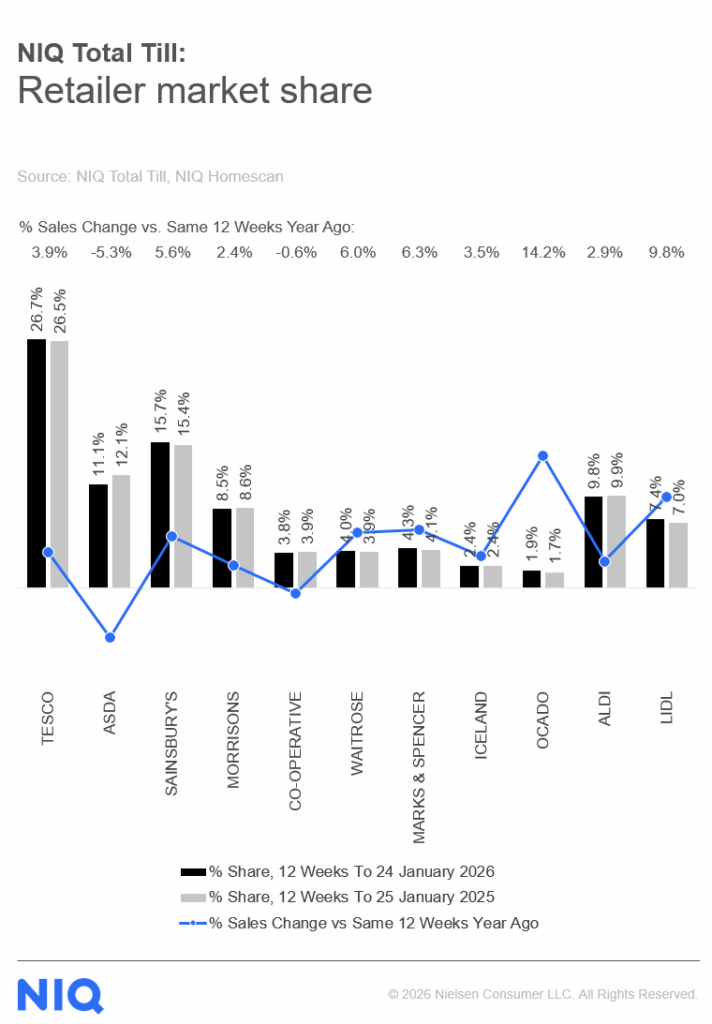 Unless otherwise stated all data is NIQ Homescan Total Till.
1 NIQ Product insights, 26 weeks to 10/1/26
2 NIQ Homescan FMCG
3 NIQ Homescan Survey November 2025
4 NIQ Scantrack Total Coverage
5 NIQ Scantrack eCommerce (Defined Multiple Grocers)
6 NIQ Digital Purchases
Comments are closed.