



- NIQ’s Consumer Outlook 2027 finds the UK is the only Western European market where shoppers are shifting away from mainstream-priced products towards value and premium alternatives
- More than half (53%) of UK shoppers say mid-range products need a clear point of difference, while 69% would rather save money if a product isn’t clearly better
- Ongoing cost-of-living pressures are driving tougher spending choices, with more shoppers turning to discount retailers (39%), switching to cheaper brands (38%) and cutting non-essential purchases (32%) altogether
UK shoppers are increasingly turning to either value or premium products, putting pressure on mainstream-priced FMCG brands, reveals new data from NielsenIQ (NIQ)’s latest Consumer Outlook: Guide to 2027 report, which outlines how financial pressures are reshaping shopping habits as consumers become more selective about where and why they spend.
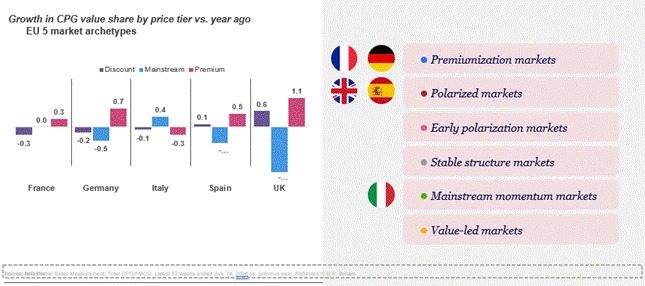
According to the report, Britain is the only market in Western Europe classified as fully ‘polarised’ with spending moving away from mainstream-priced products at both ends. While mainstream-priced FMCG products still account for the largest share of UK sales (49%), NIQ data shows they are losing ground to value and premium alternatives. Mainstream products lost -1.7 percentage points of value share year on year – the steepest decline in Western Europe – while premium products gained 1.1 points and value products 0.6 points.
This shift reflects changing UK shopper expectations, with 53% saying mid-range products need a clear point of difference to compete with cheaper or premium alternatives, while 69% would rather save money if a product isn’t clearly better. More than half (55%) also say they prefer to choose something clearly premium if they’re going to spend more – the second-highest proportion in Western Europe, behind Italy (56%).
 Affordability is key for British shoppers
Affordability remains the leading purchase consideration for UK consumers, despite the growth of premium products. Globally shoppers prioritise quality and performance over affordability (34% versus 31%), yet in the UK the opposite is true – 44% prioritise affordability compared with 29% for quality.
This comes against a challenging financial backdrop: 44% of UK shoppers reveal they feel financially worse off than a year ago, compared with 34% globally. This forms part of a wider continental trend, where 4 in 10* Western European households say they are worse off than they were last year. This is prompting consumers to cut back on discretionary spending over the next 12 months, with eating out (43%), clothing (39%) and food delivery and takeaways (38%) among the areas most likely to be affected.
However, this is also having an impact on grocery shopping behaviours. Compared with last year, more consumers are turning to discount and value retailers (39%, up from 30%) and switching to lower-priced brands (38%, up from 34%). Loyalty points remain a popular way to manage spending, with 38% of shoppers using them – unchanged year on year but well above the global average of 29%. Meanwhile, almost a third (32%) say they have stopped buying non-essential products altogether, up from 27% last year.
Despite tighter budgets, health remains a priority – and this is something that UK shoppers are willing to pay more for. NIQ data shows that 54% of UK shoppers will pay more for a product that is fresh and without preservatives. Moreover, 52% of shoppers are willing to pay more for healthy nutrition (52%), aging well (51%), healthy body weight, shape and muscle tone (47%).*
European shoppers recalibrate spending
The findings form part of trends in shopping behaviour across Europe. NIQ data shows that shoppers are making approximately 20 more shopping trips per year but purchasing less on each occasion. The average FMCG basket is now worth over €1 less and contains almost one fewer pack, although greater shopping frequency means overall spending and pack purchases have increased slightly.
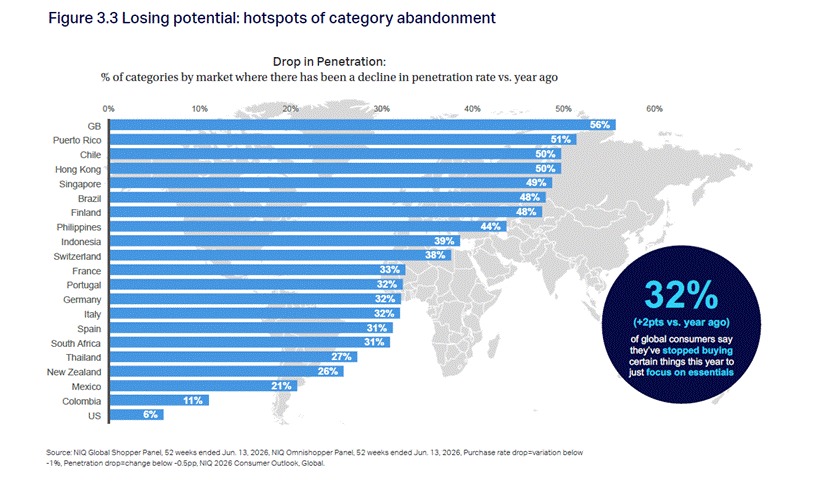 However, Great Britain is experiencing weaker growth in shopping frequency than other European markets, with price remaining the primary driver of FMCG growth and units purchased per shopper continuing to decline. These changing habits have persisted even as inflation has eased, suggesting shoppers are adjusting their spending priorities rather than returning to previous behaviours.
Julian Crane, Managing Director at NIQ, UK said: “Our data shows that British shoppers haven’t stopped spending – they’ve recalibrated. Affordability remains a priority for many UK households, which means that consumers are making tougher choices when it comes to what earns a place in their shopping basket. However, they are willing to spend on where there is a clear benefit – whether that is health-focused or something which offers indulgence. Now for retailers and brands, the challenge is to demonstrate why their products are worth buying, – whether that is via a compelling price point or a product that shows justified value to the shopper.”
For more information on Consumer Outlook: Guide to 2027, please download the full report here.
*From NIQ data report The Power Shift: How European consumers will shape growth through 2027. European shopping-frequency and basket data are based on NIQ Consumer Purchase Panels covering Great Britain, France, Germany, Italy and Spain, for the 52 weeks ending 6 September 2026. Online FMCG growth figures are from NIQ Omnisales, MAT July 2026. Other Western European findings draw on NIQ Consumer Outlook and Consumer Life research.
Comments are closed.