


Keeping customers safe and stores trading is essential during retail construction projects. Live projects in grocery environments require robust safety strategies that adapt as layouts change. By understanding and managing unique site risks, retail operations can minimise disruption and reduce incidents.
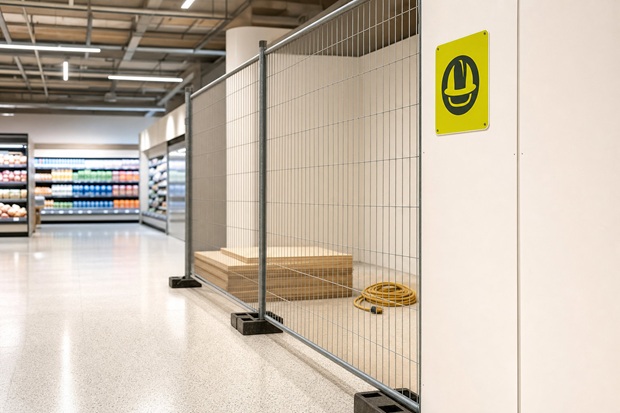 For grocery retailers, health and safety are central to protecting reputation and continuity during construction programmes. Careful planning is required to maintain trading while managing the hazards that arise whenever areas of a store become a worksite. Measures such as temporary fencing enable effective separation between operational and construction zones, supporting business continuity. This approach helps protect both public and colleague welfare throughout complex refurbishments or extension projects.
Managing risks on trading sites with high footfall
Construction safety is now a prominent concern for retailers operating in busy, open environments. Projects often need to move forward while stores stay open, requiring close cooperation between building contractors and retail teams to maintain safety.
Risks increase when customers, store colleagues, and construction workers share space. Grocery sites usually involve crowded aisles, both vehicle and pedestrian traffic, and limited back-of-house access. These conditions make it critical to keep work areas separate and manage contractor movements, especially during peak shopping times.
Effective risk management also involves scheduling construction activities around peak trading periods wherever possible. Early morning or late evening work can significantly reduce the likelihood of customer interaction with construction hazards. Retailers should establish clear protocols for emergency situations, including evacuation procedures that account for both the construction zone and the active retail space. Regular communication between site supervisors and store managers ensures that any emerging risks are identified quickly, allowing for immediate adjustments to safety measures. This collaborative approach helps maintain a secure environment even as project scopes evolve and different trades move through various phases of the build programme.
Mitigating key hazards in grocery refurbishment projects
Good retail construction safety depends on anticipating common risks. Keeping customer areas clearly divided from construction zones is important to help prevent accidental access and confusion, especially when changing internal routes due to works.
Coordinating deliveries and contractor movement within stores that are trading can help reduce the risk of collisions or unnecessary disruption to shoppers. Other considerations include dust, noise, and lighting changes; these must be controlled so that store ambience and accessibility remain suitable. Fire safety requires extra vigilance whenever there are temporary layouts, as emergency pathways can be blocked unintentionally. The use of retail hoarding establishes a clear boundary during these changes, supporting hazard reduction as work progresses.
Ensuring safe and accessible circulation for all users
Retail construction regularly affects how customers and colleagues move within the premises. Signposting updated pedestrian routes is important so that access to tills, exits, and facilities stays clear, even as project phases advance.
It is important to maintain accessible entry points and queuing systems that remain compliant, particularly where new temporary setups cause pinch points. Protecting welfare facilities is also key, as both customers and employees need reliable access to toilets and rest areas throughout the works.
Oversight, controls, and what “good” looks like in practice
Strong site safety performance results from established responsibilities within the project team. Store management, principal contractors, and facilities teams should clarify accountability for compliance tasks, such as permits to work and inductions.
Effective controls include marking work zones, prominent wayfinding, and daily safety checks. Incident reporting systems allow quick responses as site conditions change, and regular audits help sustain standards. Out-of-hours construction and phased works planning can minimise disruption and support public safety.
Performance is often monitored by tracking near-miss data, operational disruption, and customer feedback on the works. Experience from previous refurbishment projects can inform improved safety methods for future schemes in a retailer’s estate. By continually enhancing construction safety, retailers help foster trust with shoppers and colleagues and enable successful retail expansion.
Comments are closed.