


Research shows a growing nutrition gap as dairy cooperative Arla calls for collaborative action to change the food conversation and help Britain eat better
 The UK is facing a hidden nutrition crisis, with millions failing to get essential nutrients despite growing awareness of healthy eating – a systemic challenge that requires joined-up action across policy, industry and the wider food system.
 New research from Arla’s ‘Plate of the Nation’ reveals a stark “nutrition gap” – a hidden crisis where people are consuming enough calories but missing essential nutrients.
‘Plate of the Nation’, a new annual initiative, combines consumer insight with a review of national nutrition data compiled by the British Nutrition Foundation and offers one of the most comprehensive views of how the UK eats today – and why so many people are struggling to eat well.
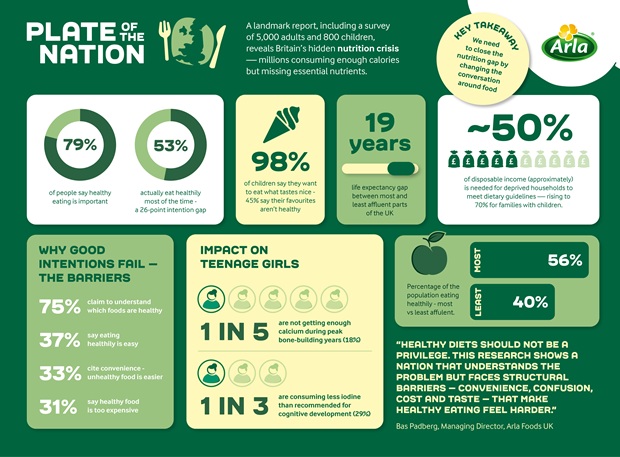
A survey of 5,000 adults and 800 children conducted by YouGov, showed that while 79% of people say healthy eating is important, only 53% actually eat healthily most of the time.
The research shows that while awareness of healthy eating is high, many people feel unable to act on it due to a combination of confusion, time constraints, cost pressures and unequal access to nutritious food.
A food system making healthy choices harder
The data reveals why good intentions fail. While 75% of adults claim they understand which foods are healthy, only 37% say eating a healthy diet is easy.
The obstacles are concrete and measurable: 33% cite convenience as a barrier – unhealthy food is simply easier; 31% say healthy food is too expensive (rising to higher levels among Gen Z and lower-income households); 24% admit unhealthy food tastes better. For children, taste is even more powerful: 98% say they want to eat what tastes nice, and 45% say “my favourite foods aren’t healthy”.
Tellingly, 1 in 5 adults (22%) admit “I don’t care much about what’s in my food as long as it tastes good” – a figure that rises to 30% among Gen Z and 25% among C2DE* households.
Teenagers at risk
Among the most concerning findings are low intakes of key nutrients hitting teenage girls during critical development years.
Nearly 1 in 5 teenage girls (18%) are not getting enough calcium during peak bone-building years, while 1 in 3 girls aged 11–18 (29%) consumes less iodine than recommended, important for cognitive development.
These issues are occurring during the teenage years when eating habits shift and long-term health outcomes begin to take shape. What’s missing now may not show consequences for decades.
A postcode lottery for nutrition
The economic reality shows that the most deprived households would need to spend around 50% of their disposable income to meet government-recommended dietary guidelines. For families with children in the most deprived households, that figure rises to 85%.[1]
Within C2DE households, a fifth of the population eat significantly less healthily, with only 48% managing to do so “most of the time” compared to 56% in the most affluent group. Healthy life expectancy – the years lived in good health – differs by up to nineteen years between the most and least affluent parts of the UK.[2]
Bas Padberg, Managing Director at Arla Foods UK, said: “Healthy diets should be available to everyone. This research shows a nation that understands the problem but faces structural barriers – convenience, confusion, cost and taste – that make healthy eating feel harder. That includes the everyday moments that shape our diets – like breakfast – where small changes can make a positive difference.
“For decades, the conversation around food has focused on what to avoid – things like sugar, salt and fat. And whilst we know that’s a public health crisis we have to address, it’s also time to look at how we can help people see what they should be eating and change the conversation around our food.
“Closing the nutrition gap is bigger than any one company or any one policy. We need to change the environment people are navigating every day. It will take businesses, government, educators, health professionals and communities working together.”
Elaine Hindal, Chief Executive of the British Nutrition Foundation, said: “This report highlights a growing ‘nutrition gap’ in the UK, where many people are consuming enough calories, but insufficient amounts of the nutrients needed to support good health. Poor diet is now a leading contributor to preventable ill health, particularly affecting young people and those in more disadvantaged communities.
“Closing this gap will require action across the whole food system. Clear, evidence-based information, alongside supportive food environments, is essential to help people make healthier choices in their everyday lives. Initiatives such as this can play a valuable role in informing the conversation and supporting practical, science-led approaches to improving population health.”
Padberg added: “We want to open the door to partners who share our ambition: to build a healthier, fairer food system, one that serves people, strengthens communities and delivers lasting change. This is a long-term commitment, and we’re determined to play our part.”
Collaboration needed to build a healthier Britain
In response to the findings, Arla is calling for action across three areas:
- Food literacy– cutting through confusion with clear, trusted information
- Food culture – making good nutrition feel desirable for everyone; and
- Food access – ensuring nutritious food is within reach for all
As a first step, Arla is committing to a review of its own on-pack labelling, exploring how it can better reflect positive nutrition and help shoppers understand not just what to cut back on, but what their bodies genuinely need.
To support young people with understanding food, Arla will also undertake a school outreach programme, aiming to reach 250,000 children and teenagers by the end of 2027 with information, education and inspiration about healthy, nutritious food.
It is also committing to build on its existing access programmes and will donate 4million meals in the next year through its impact partnerships, including its work with Magic Breakfast and Felix**, as part of a long-term effort to improve access to nutritious food for children and families who need it most. Breakfast is a key occasion to close the nutrition gap — providing a simple, accessible moment to fuel healthier choices from the start of the day. Through its partnerships, Arla will support nutritious breakfast options, helping more people begin the day with the nutrients they need.
In addition to its own commitments on labelling and impact partnerships, Arla is calling on businesses, government, retailers, educators, health professionals and community organisations to join a collective effort to close Britain’s nutrition gap.
[1] Food Foundation (2026). The Broken Plate 2026: The State of the Nation’s Food System. Food Foundation, London. Analysis by London School of Hygiene & Tropical Medicine. Food insecurity figures also draw on Food Standards Agency and DHSC food security data.
[1] Food Foundation (2026). The Broken Plate 2026: The State of the Nation’s Food System. Food Foundation, London. Analysis by London School of Hygiene & Tropical Medicine. Food insecurity figures also draw on Food Standards Agency and DHSC food security data.
*C2DE classification for three lower socio-economic groups.
**Felix is the new name for merged charities FareShare and The Felix Project.
Comments are closed.